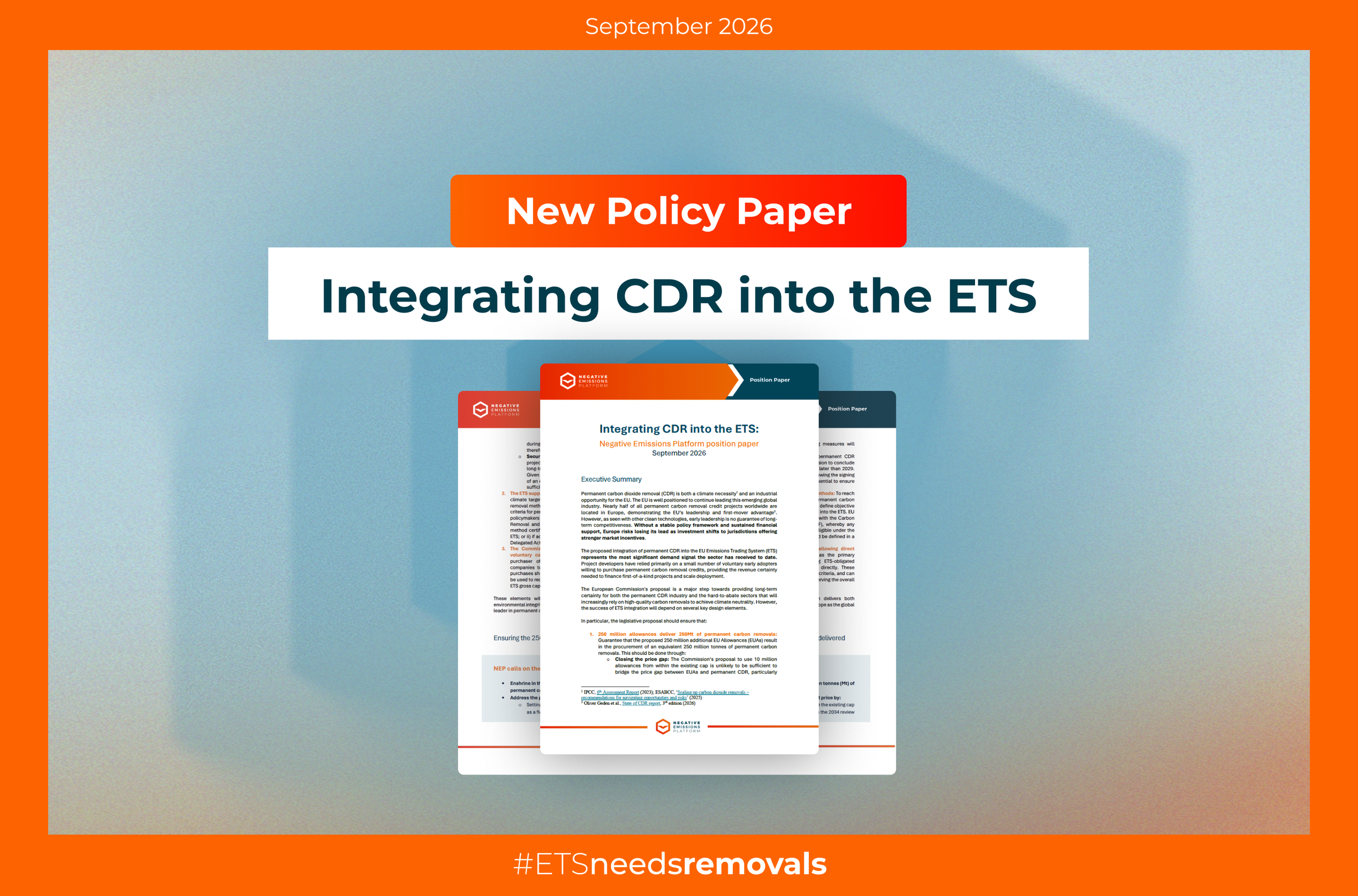

ETS needs carbon removals
Carbon removals in the ETS can support both European industry and the climate. But this will only work if their integration is done correctly.
-
![]()
Industry needs carbon removals
-
![]()
Climate needs carbon removals
-
![ETS needs carbon removals]()
ETS needs carbon removals
-
![The ETS needs carbon removals]()
Europe needs carbon removals


Our Checklist for Success
The Negative Emissions Platform has devised 3 principles and 6 actions - it’s the checklist for a successful integration of carbon removals into the ETS
-
![Check mark]()
Make 250 million allowances deliver 250 million tonnes of permanent carbon removals
Actions:
1.Guarantee delivery of the full 250 Mt. Enshrine the procurement of 250 million tonnes of permanent carbon removals between 2031 and 2040. Every additional allowance must be matched by an equivalent permanent removal, with the certified unit purchased, delivered and cancelled, ensuring that integration does not increase net emissions under the ETS.
2.Maintain the like-for-like principle. Only permanent carbon removals should compensate for permanent fossil emissions. Carbon farming and other temporary removals should remain outside the ETS compliance framework and be supported through dedicated policy instruments.
3.Close the price gap. The 10 million allowances earmarked from within the existing cap should be a floor, not a ceiling, complemented by making permanent removals a priority for Member States’ ETS revenues and supporting them through both phases of the Industrial Decarbonisation Bank, including Carbon Contracts for Difference.
-
![Checkmark]()
Ensure supply of permanent carbon removals by 2031
Actions:
4. Secure long-term offtake agreements early. Enable the European Commission to conclude agreements as soon as possible and no later than 2029. Agreements lasting at least eight years will help projects reach final investment decisions and begin delivering removals from 2031.
-
![Checkmark]()
Build a broad, high-integrity market
Actions:
5. Keep the Commission as the primary purchaser to ensure long-term revenue certainty while enabling complementary direct purchases. This complementary demand can accelerate investment and provide additional revenue certainty for removal providers. This would accelerate investment in permanent CDR. These purchases must count towards the 250 Mt allocation. Removal providers should also be able to access both compliance and voluntary market demand.
6. Enable a broad portfolio of permanent carbon removal methods. Establish clear and objective eligibility criteria, either through full alignment with permanent removals certified under the CRCF or through additional criteria set out in a Delegated Act within 12 months of the revised Directive’s adoption. Additional methods should be admitted on a rolling basis as they meet the requirements.




Industry needs carbon removals
Industry needs carbon removals because:
-
![ETS needs carbon removals]()
Hard-to-abate industries will need permanent carbon removals to reach net zero.
-
![Checkmark]()
Carbon removals can unlock new revenue streams for European industry.
-
![Checkmark]()
Carbon removals are an industrial growth opportunity for Europe.

Climate needs carbon removals
Every credible pathway to climate neutrality requires carbon removals to address residual emissions from hard-to-abate sectors
-
![Check mark]()
Carbon removals are essential for achieving net zero and stabilising the climate.
-
![Checkmark]()
The world is far from deploying carbon removals at the scale required.
-
![Checkmark]()
Delaying carbon removals will make climate action more difficult and more expensive.

ETS needs carbon removals
-
![Check mark]()
Maintain a functioning & effective carbon market beyond 2030
-
![Checkmark]()
Help stabilise the ETS price

Europe needs carbon removals
-
![Check mark]()
Building a credible demand signal for permanent carbon removals through the ETS.
-
![Checkmark]()
Safeguarding Europe’s first-mover advantage in a globally competitive carbon removal market.
-
![Checkmark]()
The critical policy window to unlock investment and scale deployment before 2031.
Industry voices
-
![Why must the EU ETS integrate permanent carbon removals after 2030?]()
Why must the EU ETS integrate permanent carbon removals after 2030?
-
![What needs to happen now for ETS integration to succeed]()
What needs to happen now for ETS integration to succeed
-
![The jobs resulting from scaling carbon removal in Europe]()
What kinds of jobs does scaling your CDR technology create in Europe?
-
![What role should international permanent removals play in emissions trading systems, including through potential UK-EU ETS linking?]()
What role should international permanent removals play in emissions trading systems, including through potential UK-EU ETS linking?
-
![The unresolvable cost burden without CDR in the ETS]()
Without CDR integration into the ETS, do hard-to-abate industries simply face an unresolvable cost burden on residual emissions?
-
![The environmental co-benefits of carbon removal]()
What are the environmental co-benefits of carbon removals?
-
![Post-2030 ETS: the case for permanent removals]()
Post-2030 ETS: the case for permanent removals
-
![One target change that could unlock removals]()
One target change that could unlock removals
-
![Carbon removals and industry competitiveness in the ETS]()
Carbon removals and industry competitiveness in the ETS
-
![CDR integration and the cost burden on hard-to-abate sectors]()
CDR integration and the cost burden on hard-to-abate sectors






Mainstreaming carbon removals in EU law
-
![]()
Emissions Trading System
The EU should integrate permanent carbon dioxide removals into the ETS through a phased approach that builds long-term demand and revenue certainty while preserving the system’s environmental integrity. This would start with public funding and intermediary-led procurement, followed by the gradual inclusion of certified permanent removals without increasing the ETS cap. It should also be backed by separate CDR targets in EU climate law and strong safeguards so that only high-integrity, permanent removals are eligible.
-
![]()
EU Climate Law
The EU Climate Law should be strengthened to support both climate neutrality by 2050 and the growth of a competitive permanent carbon dioxide removal industry. This means setting a 90% net emissions reduction target for 2040, alongside separate targets for gross emissions reductions, permanent CDR and LULUCF, backed by a broader support package beyond ETS integration. It should also include strong safeguards for any international credits and support a portfolio of permanent CDR methods to ensure consistency across EU policies.
-
![]()
Green Claims Directive
The Green Claims Directive proposed by the European Commission is crucial for combating greenwashing and promoting investment in permanent carbon removal. This directive would require companies to substantiate and communicate their environmental claims, including guidelines on using carbon credits.
-
![Making a short-term EU purchasing programme work for CDR]()
Making a short-term EU purchasing programme work for permanent CDR
The EU should scale permanent carbon dioxide removal by 2030 through near-term support, including an EU Buyers’ Club, results-based payments for verified removals, and a pathway from a €1 billion pilot in 2026 to longer-term support through the Industrial Decarbonisation Bank. It should also make CDR visible in key EU funding instruments, support large-scale R&D through FP10, and secure long-term funding to strengthen competitiveness, jobs and climate goals.
-
![CDR in the Multiannual Financial Budget]()
CDR in the Multiannual Financial Budget
The EU budget will help decide which net-zero technologies scale in Europe, but carbon dioxide removal is still not clearly included in funding priorities. To protect competitiveness, jobs and climate goals, the EU should make CDR eligible in key funding instruments, support large-scale R&D through FP10, and secure long-term funding as negotiations move forward.