

Policy Positions
We believe in openness and transparency. This is why you will find below all the policy positions produced by the Negative Emissions Platform and representing the views of our members.

EU Policy Positions
-
This paper outlines four key measures to ensure the EU ETS can create the demand, funding and investment certainty needed to scale permanent carbon removal in Europe, while supporting the continent’s industrial transition.
Access here -
The Negative Emissions Platform (NEP) calls for the integration of permanent carbon dioxide removals (CDR) into the EU Emissions Trading System (ETS) through a phased approach. This would support the EU’s path to net-zero by creating long-term demand and revenue certainty for the CDR sector, while maintaining the environmental integrity of the ETS. NEP proposes starting with public funding and intermediary-led procurement, followed by gradual integration of certified permanent CDRs without increasing the ETS cap. The paper stresses the need for separate targets for CDR in EU climate law, alignment with the CRCF, and safeguards to ensure only high-integrity, permanent removals are eligible
-
EU Climate Law Position Paper (July 2025) sets out the Negative Emissions Platform’s recommendations for strengthening the EU Climate Law revision so Europe can reach climate neutrality by 2050 while enabling a competitive permanent carbon dioxide removal (CDR) industry to invest and scale. It calls for a 90% net emissions reduction target by 2040, separate targets for gross emissions reductions, permanent CDR and LULUCF, and a holistic package of support measures beyond ETS integration. The paper also urges robust safeguards for any use of international credits and a portfolio approach to permanent CDR methods, aligned with the CRCF, to avoid narrowing support to only a few technologies and to ensure policy coherence across EU instruments.
Access here -
A coalition of carbon market organisations, including NEP, welcomes the EU's decision to allow up to 5% international carbon credits toward the 2040 climate target — and calls on the Commission to ensure high-integrity carbon removal credits play an explicit role in that framework from the outset.
The paper sets out two core recommendations: that CDR credits be prioritised within the international credit mix from the start, with their share growing over time in line with science-based pathways; and that any pilot phase, beginning around 2031, explicitly include carbon removal credits to allow supply to scale and verification infrastructure to mature. The paper also makes the case for Europe's competitive advantage as the only jurisdiction with an operational CDR certification framework (the CRCF), the EU is well-placed to anchor global quality standards while building an industry projected to reach €940 billion annually by 2050.
Download the Policy Recommendation -
Making Carbon Removal Work for Europe: A Scale-Up Strategy for 2026–2030 sets out how the EU can scale permanent carbon removals from today’s limited capacity to at least 5 million tonnes annually by 2030. The paper argues that Europe needs urgent action to create early demand, mobilise deployment funding, strengthen research and innovation, accelerate CRCF methodology development, and build the practical foundations for future integration of removals into compliance markets such as the EU ETS. It frames carbon removal as essential for industrial competitiveness, climate credibility, and Europe’s clean-tech leadership.
-
Making a Short-Term EU Purchasing Programme Work for Permanent CDR is NEP’s new discussion paper on how the EU can accelerate permanent carbon dioxide removal between now and 2030—before long-term integration into the EU ETS is settled. It sets out practical design options for near-term purchasing support, including an EU Buyers’ Club to aggregate demand, results-based per-tonne revenue support paid on CRCF-verified delivery, and a predictable multi-year pathway starting with a €1 billion pilot in 2026, with longer-term scaling supported through the Industrial Decarbonisation Bank.
Make CDR eligible and visible in the European Competitiveness Fund (Clean Transition & Industrial Decarbonisation window)
Fund R&D at scale through FP10, so European carbon removal technologies can mature and deploy
Protect industrial competitiveness and jobs by enabling durable removals alongside emissions cuts
Now is the negotiation window for Member States and the European Parliament to secure long-term funding for carbon removals.
Discussion paper -
Access the open letter:
-
NEP welcomes the draft Delegated Act as a milestone in implementing the Carbon Removal Certification Framework and calls for its rapid adoption. In its response, NEP stresses the need for:
Longer activity periods (up to 15 years) to align with financing structures and ensure project viability.
Broader recognition of operators, allowing both capture and storage actors to register activities and trigger issuance of units.
Greater flexibility for DACCS, including annual temporal matching for first-mover projects, recognition of Guarantees of Origin for renewable electricity, and inclusivity for different sorbent processes.
Consistency with RED for BioCCS, particularly on sustainability rules, cascade principle application, reporting requirements, and treatment of new or mothballed facilities.
Practical rules for biochar (BCR), ensuring permanence is defined by stable carbon fractions, clarifying unit issuance for batches, and confirming soil application limits.
Overall, NEP supports a clear, consistent, and investment-friendly framework to enable the growth of permanent carbon removals in Europe
Consultation Response -
Durable carbon dioxide removal (CDR) contributes to climate and economic goals. With removal capacity urgently needing to scale up—in terms of technology development and the creation of lead markets—the window for timely, effective investment is closing. We believe that the European Investment Bank (EIB) Group is uniquely placed to provide the financial and technical assistance required to facilitate both research and innovation and deployment-level investments aligned with the scale of durable CDR needed in the EU.
Response to Consultation on the EIB Climate Bank Roadmap 2026-2030 -
The Negative Emissions Platform calls for the European Innovation Council (EIC) to launch dedicated funding calls for carbon dioxide removal (CDR) technologies. These technologies—crucial for meeting the EU’s 2040 and 2050 climate targets—require urgent research, development, and innovation (RD&I) support to scale up and ensure a reliable pipeline of high-integrity carbon removals. Despite growing investor interest, early-stage CDR companies face a significant funding gap, compounded by policy uncertainty and high technical risk. The EIC, with its deep-tech mandate and blended finance instruments, is well-positioned to fill this gap and accelerate breakthrough innovations, enabling the EU to lead in climate tech while generating jobs and industrial competitiveness.
NEP Position -
The Industrial Decarbonisation Accelerator Act (IDAA) offers a vital opportunity for the EU to scale up permanent carbon dioxide removal (CDR) – a critical tool for energy-intensive industries to reach net-zero and, ultimately, net-negative emissions.
To support this goal, NEP proposes a comprehensive list of policy actions.
NEP Position Paper -
The Negative Emissions Platform (NEP) welcomes the opportunity to provide input to the EU’s Bioeconomy Strategy revision. As a crosssectoral coalition of organisations developing permanent carbon dioxide removal (CDR) solutions, we urge the Commission to anchor permanent carbon removal as a strategic priority within the bioeconomy framework.
The revised strategy must support both the scale-up of negative emissions technologies and the creation of robust markets that recognise their climate and co-benefits.
NEP Response -
The upcoming €100B Industrial Decarbonisation Bank (IDB) is a strategic opportunity to scale permanent carbon removal (CDR) and boost Europe’s industrial competitiveness.
In our latest paper, NEP calls on the European Commission to:
Allocate 5% of IDB funds to CRCF-certified permanent CDR
Use fit-for-purpose funding instruments like CfDs, offtakes, or fixed premiums to scale up carbon removals
Provide hard-to-abate industries with preferential access to IDB-supported permanent CDR
This is how the IDB can bridge innovation to market—scaling clean industry, cutting residual emissions, and delivering on the Clean Industrial Deal.
-
European startups are leading in developing permanent carbon dioxide removal (CDR) technologies but are nearing the “valley of death”. The EU is home to a vibrant scene of startups and scaleups delivering negative emissions, but they currently face significant barriers, particularly in financing.
The EU has an opportunity to safeguard critical industries and grow the nextgeneration of clean-tech startups by 2030 which requires urgent action. The Start-up and Scale-up Strategy presents an important opportunity to accelerate the next generation of clean technologies and achieve Europe’s climate and competitiveness goals. -
NEP welcomes the European Commission’s initiative to develop a comprehensive ocean policy in the European Oceans Pact and appreciates the opportunity to provide input.
NEP calls on the European Commission to integrate marine carbon dioxide removal (CDR) into the EU’s ocean policy framework as an important contributor to the EU’s climate goals and to support climate mitigation efforts.
-
44 organisations have signed a joint letter calling on the European Commission to ensure the Clean Industrial Deal supports investment, innovation, and deployment in carbon dioxide removal (CDR), a cornerstone of Europe’s path to climate neutrality.
Key asks:
Streamline permitting processes to accelerate CDR deployment.
Establish an Important Project of Common European Interest (IPCEI) for CDR to foster cross-border coordination.
Introduce competitive financial incentives to attract and retain CDR companies.
Invest in Workforce Development to support a growing CDR industry and ensure a just transition.
Open letter (05.02.2025)
-
The Net-Zero Industry Act (NZIA) creates a regulatory framework to boost the competitiveness of EU industry and technologies crucial for decarbonisation.
NEP advocated for the inclusion of carbon removals in the NZIA.
-
On 19 February 2024, the European Commission reached a provisional political agreement on the Carbon Removals and Carbon Farming Regulation (CRCF), a voluntary regulatory framework for the certification of permanent carbon removals, carbon farming and carbon storage in products. The framework has been developed to facilitate and speed up the deployment of permanent carbon removal, carbon farming and carbon storage in products activities, as a complement to sustained emission reductions, fight greenwashing and harmonise carbon removal market conditions.
-
The Negative Emissions Platform’s response to the EU Legislative Initiative on CO₂ Transportation Infrastructure and Markets (September 2025) outlines how Europe can build CO₂ transport and storage systems that are fit for both CCS and permanent carbon dioxide removal (CDR) at industrial scale. It calls for explicit inclusion of permanent CDR in infrastructure planning and market access rules, proposes launching two IPCEIs (one for CO₂ transport & storage and one for permanent CDR scale-up), and recommends an EU strategy for permanent CDR to align demand- and supply-side measures across EU and national policies—ensuring removals are not crowded out and that infrastructure becomes a backbone for net zero and net negative emissions.
Access paper -
Negative Emissions Platform supports the Commission’s initiative to design a Carbon Removal Certification Mechanism (CRC-M). We encourages the Commission to provide a framework that is robust, credible, implementable and establishes comprehensive and robust rules for each type of carbon removal, on top of a common EU minimum standard. A timely development of methodologies to enable policy support is critical. We call on the Commission to implement methodologies as soon as possible, i.e. when robust assessments are achieved. Difficulties in the assessment of certain CDR methods should not undermine progress towards implementation of approaches which are ready to be incentivized to scale in the short-term.

National Policy Positions
-
The UK is leading the way with assessing how GGRs can be integrated into the UK Emissions Trading Scheme (ETS). NEP expects that the UK’s decision on how to integrate GGRs in the ETS will have significant climate impacts as other countries and regions (like the EU) look for direction on adopting similar measures.
-
This is a consultation from the Federal Ministry for Finance and the Federal Ministry for Climate Action, Environment, Energy, Mobility, Innovation and Technology on Austria’s upcoming Carbon Management Strategy. This is a critical opportunity to promote the adoption of carbon removal technologies in Austria, positioning the country to achieve its climate objectives in the upcoming decades.
-
The Negative Emissions Platform (NEP) applauds the publication of the draft CCUS Strategy developed jointly by the AGH University of Science and Technology and the WiseEuropa Foundation as part of the CCUS.pl project.National level action on carbon management will be critical in driving these climate critical technologies forward, and we are encouraged to see frontrunners in Poland already taking proactive measures in this domain. NEP is encouraged to see some carbon dioxide removal (CDR) technologies included in the draft CCUS Strategy. While this is undoubtedly a positive starting point, NEP strongly believes that the draft strategy could elevate Poland’s ambition and comprehensiveness in this regard. Effective CDR initiatives are essential for achieving long-term climate goals, and Poland is well-positioned to lead in this area.
NEP proposes 8 key actions needed to enhance the role of permanent CDR in the Polish landscape.
Position Paper

Global Policy Positions
-
SBTi’s updated draft Corporate Net-Zero Standard (CNZS 2.0) introduces useful concepts, but as written it risks falling short on what permanent carbon removals need: a clear, early, and predictable demand signal. NEP is particularly concerned about proposed co-claiming restrictions, non–science-aligned durability guidance (missing a like-for-like approach), and a timeline that makes action on removals mandatory too late—all of which could weaken net-zero credibility and slow scale-up.
-
With thousands of companies committing to science-based targets, the Science-Based Targets initiative (SBTi) plays a central role in shaping credible corporate climate strategies. Its upcoming revision of the Corporate Net-Zero Standard (CNZS 2.0) could significantly accelerate the growth of the permanent carbon removal (CDR) sector.
The update acknowledges that most companies will face unavoidable residual emissions on the path to net-zero — and will need to address these through carbon removals. Of the proposed approaches, only one creates a strong demand signal: interim targets for CDR purchases starting in 2030. To be effective, these must be annual (not cumulative), apply beyond Scope 1, and reflect the need for permanence when neutralising fossil-based emissions.
Further recommendations include clear guidance for tackling Scope 3 residuals through structured glidepaths, and stronger incentives to support removals beyond company value chains. Recognising early investment in high-quality, permanent CDR — for example through Beyond Value Chain Mitigation (BVCM) — will be critical for scaling supply in line with future demand.
These changes are key to preserving the integrity of net-zero claims — while giving companies a clearer, investable path to decarbonisation that includes long-term removals at its core.
Read Response -
The Negative Emissions Platform welcomes the Article 6.4 Supervisory Body’s structured public consultation on removal activities. As the Supervisory Body gathers input, NEP would like to draw attention to some important elements it should consider regarding monitoring and reporting and addressing reversals.
-
The Negative Emissions Platform, alongside 7 prominent members in the CDR ecosystem, call on the UNFCCC to address the unbalanced representation of engineered carbon removal benefits, discrepancies in CO2 quantification, and misrepresentation of long-term storage benefits and its role.
-
Negative Emissions Platform has responded to the consultation by Verra concerning a “labeling” of Verified Carbon Units (VCUs/carbon credits). In its proposal, Verra is following much of the work and recommendations of the Taskforce Scaling Voluntary Carbon Markets (TSVCM) as regards the pending Core Carbon Principles that are likely issued very soon by the newly established Integrity Council. We encourage Verra to clearly differentiate carbon removals and reduction credits by establishing a new credit unit for carbon removal projects. We also encourage Verra to focus on capture method and storage timeframes to categorize removals.
Central EU Strategy
Make Carbon Removals a Strategic Pillar with Separate Targets for a Competitive, Net Zero Europe
-
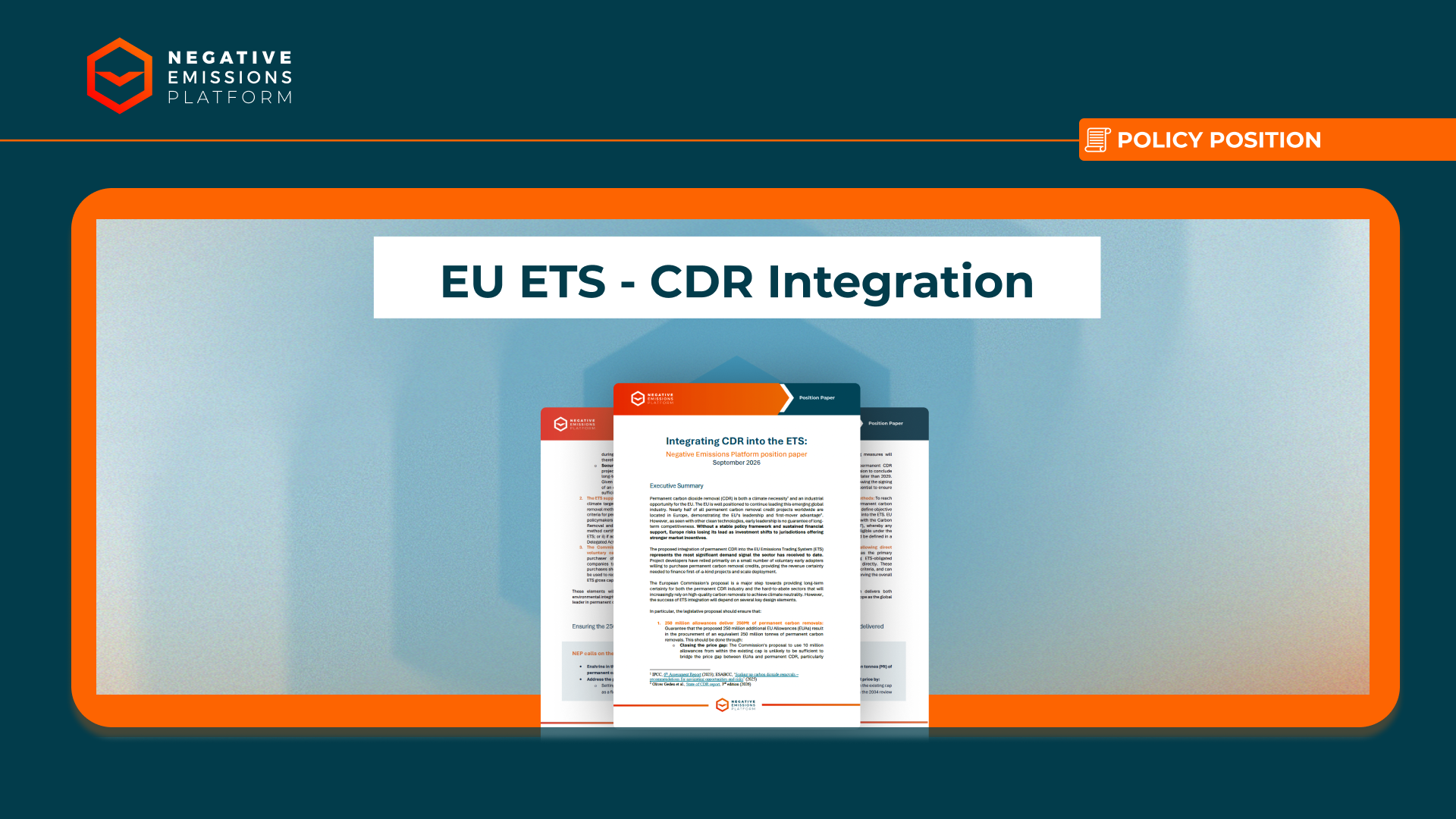
EU ETS - CDR Integration
The Negative Emissions Platform calls for the integration of permanent carbon dioxide removals into the EU Emissions Trading System through a phased approach. This would support the EU’s path to net-zero by creating long-term demand and revenue certainty for the CDR sector, while maintaining the environmental integrity of the ETS. NEP proposes starting with public funding and intermediary-led procurement, followed by gradual integration of certified permanent CDRs without increasing the ETS cap.
The paper stresses the need for separate targets for CDR in EU climate law, alignment with the CRCF, and safeguards to ensure only high-integrity, permanent removals are eligible
-

The EU ETS is Europe’s chance to lead the world in permanent carbon removal as part of its industrial transition
This paper outlines four key measures to ensure the EU ETS can create the demand, funding and investment certainty needed to scale permanent carbon removal in Europe, while supporting the continent’s industrial transition.
-

Making Carbon Removal Work for Europe: A Scale-Up Strategy for 2026–2030
Making Carbon Removal Work for Europe: A Scale-Up Strategy for 2026–2030 sets out how the EU can scale permanent carbon removals from today’s limited capacity to at least 5 million tonnes annually by 2030. The paper argues that Europe needs urgent action to create early demand, mobilise deployment funding, strengthen research and innovation, accelerate CRCF methodology development, and build the practical foundations for future integration of removals into compliance markets such as the EU ETS. It frames carbon removal as essential for industrial competitiveness, climate credibility, and Europe’s clean-tech leadership.
-

EU Climate Law Position Paper
EU Climate Law Position Paper (July 2025) sets out the Negative Emissions Platform’s recommendations for strengthening the EU Climate Law revision so Europe can reach climate neutrality by 2050 while enabling a competitive permanent carbon dioxide removal (CDR) industry to invest and scale. It calls for a 90% net emissions reduction target by 2040, separate targets for gross emissions reductions, permanent CDR and LULUCF, and a holistic package of support measures beyond ETS integration. The paper also urges robust safeguards for any use of international credits and a portfolio approach to permanent CDR methods, aligned with the CRCF, to avoid narrowing support to only a few technologies and to ensure policy coherence across EU instruments.
-

2040 Climate Targets
The 2021 European Climate Law demands that the 2040 Climate Targets will need to put the EU on track for achieving climate neutrality by 2050.
On 6 February, the European Commission published its Industrial Carbon Management Strategy. This strategy outlines how carbon capture and storage (CCS) and carbon dioxide removal (CDR) technologies could help reduce emissions by 90% by 2040, and achieve climate neutrality by 2050.
-
Boosting EU Competitiveness through Carbon Removals
This paper discusses the important role carbon dioxide removal (CDR) technologies can play in enhancing the EU's competitiveness, highlighting the sector’s economic potential, and what policies are needed to realise this potential. The EU has the chance to lead in carbon dioxide removal (CDR) by adopting forward-thinking policies and investing in the sector, which could boost jobs and competitiveness. However, it faces global competition from the US and China. Key policies like the Clean Industrial Deal and a CDR Strategy are needed to drive innovation. Significant public and private funding, through programs like the Innovation Fund and tax incentives, is essential to meet climate goals and scale up CDR.
-

Using International Carbon Credits to achieve a 90% emission reduction by 2040.png 2040.
A coalition of carbon market organisations, including NEP, welcomes the EU's decision to allow up to 5% international carbon credits toward the 2040 climate target — and calls on the Commission to ensure high-integrity carbon removal credits play an explicit role in that framework from the outset.
The paper sets out two core recommendations: that CDR credits be prioritised within the international credit mix from the start, with their share growing over time in line with science-based pathways; and that any pilot phase, beginning around 2031, explicitly include carbon removal credits to allow supply to scale and verification infrastructure to mature. The paper also makes the case for Europe's competitive advantage as the only jurisdiction with an operational CDR certification framework (the CRCF), the EU is well-placed to anchor global quality standards while building an industry projected to reach €940 billion annually by 2050.
-

CRCF Delegated Act on Permanent CDR Methodologies: NEP response
NEP welcomes the draft Delegated Act as a milestone in implementing the Carbon Removal Certification Framework and calls for its rapid adoption. In its response, NEP stresses the need for:
Longer activity periods (up to 15 years) to align with financing structures and ensure project viability.
Broader recognition of operators, allowing both capture and storage actors to register activities and trigger issuance of units.
Greater flexibility for DACCS, including annual temporal matching for first-mover projects, recognition of Guarantees of Origin for renewable electricity, and inclusivity for different sorbent processes.
Consistency with RED for BioCCS, particularly on sustainability rules, cascade principle application, reporting requirements, and treatment of new or mothballed facilities.
Practical rules for biochar (BCR), ensuring permanence is defined by stable carbon fractions, clarifying unit issuance for batches, and confirming soil application limits.
Overall, NEP supports a clear, consistent, and investment-friendly framework to enable the growth of permanent carbon removals in Europe
-

EIB Climate Bank Roadmap
Durable carbon dioxide removal (CDR) contributes to climate and economic goals. With removal capacity urgently needing to scale up—in terms of technology development and the creation of lead markets—the window for timely, effective investment is closing. We believe that the European Investment Bank (EIB) Group is uniquely placed to provide the financial and technical assistance required to facilitate both research and innovation and deployment-level investments aligned with the scale of durable CDR needed in the EU.
-

The Case for Dedicated Carbon Dioxide Removal Calls in the European Innovation Council (EIC)
The Negative Emissions Platform calls for the European Innovation Council (EIC) to launch dedicated funding calls for carbon dioxide removal (CDR) technologies. These technologies—crucial for meeting the EU’s 2040 and 2050 climate targets—require urgent research, development, and innovation (RD&I) support to scale up and ensure a reliable pipeline of high-integrity carbon removals. Despite growing investor interest, early-stage CDR companies face a significant funding gap, compounded by policy uncertainty and high technical risk. The EIC, with its deep-tech mandate and blended finance instruments, is well-positioned to fill this gap and accelerate breakthrough innovations, enabling the EU to lead in climate tech while generating jobs and industrial competitiveness.
-
Industrial Decarbonisation Accelerator Act
The upcoming €100B Industrial Decarbonisation Bank (IDB) is a strategic opportunity to scale permanent carbon removal (CDR) and boost Europe’s industrial competitiveness.
In our latest paper, NEP calls on the European Commission to:
Allocate 5% of IDB funds to CRCF-certified permanent CDR
Use fit-for-purpose funding instruments like CfDs, offtakes, or fixed premiums to scale up carbon removals
Provide hard-to-abate industries with preferential access to IDB-supported permanent CDR
This is how the IDB can bridge innovation to market—scaling clean industry, cutting residual emissions, and delivering on the Clean Industrial Deal.
-

EU Start-up and Scale-up Strategy
European startups are leading in developing permanent carbon dioxide removal (CDR) technologies but are nearing the “valley of death”. The EU is home to a vibrant scene of startups and scaleups delivering negative emissions, but they currently face significant barriers, particularly in financing.
The EU has an opportunity to safeguard critical industries and grow the nextgeneration of clean-tech startups by 2030 which requires urgent action. The Start-up and Scale-up Strategy presents an important opportunity to accelerate the next generation of clean technologies and achieve Europe’s climate and competitiveness goals. -
European Oceans Pact Public Consultation
NEP welcomes the European Commission’s initiative to develop a comprehensive ocean policy in the European Oceans Pact and appreciates the opportunity to provide input.
NEP calls on the European Commission to integrate marine carbon dioxide removal (CDR) into the EU’s ocean policy framework as an important contributor to the EU’s climate goals and to support climate mitigation efforts.
-

Clean Industrial Deal
Open letter · 5 February 2025
44 organisations have signed a joint letter calling on the European Commission to ensure the Clean Industrial Deal supports investment, innovation, and deployment in carbon dioxide removal (CDR), a cornerstone of Europe’s path to climate neutrality. -

Net Zero Industry Act
The Net-Zero Industry Act (NZIA) creates a regulatory framework to boost the competitiveness of EU industry and technologies crucial for decarbonisation.
NEP advocated for the inclusion of carbon removals in the NZIA.
-

Carbon Removals and Carbon Farming Regulation
On 19 February 2024, the European Commission reached a provisional political agreement on the Carbon Removals and Carbon Farming Regulation (CRCF), a voluntary regulatory framework for the certification of permanent carbon removals, carbon farming and carbon storage in products. The framework has been developed to facilitate and speed up the deployment of permanent carbon removal, carbon farming and carbon storage in products activities, as a complement to sustained emission reductions, fight greenwashing and harmonise carbon removal market conditions.
-

CO₂ Transportation Infrastructure Legislative Package
The Negative Emissions Platform’s response to the EU Legislative Initiative on CO₂ Transportation Infrastructure and Markets (September 2025) outlines how Europe can build CO₂ transport and storage systems that are fit for both CCS and permanent carbon dioxide removal (CDR) at industrial scale. It calls for explicit inclusion of permanent CDR in infrastructure planning and market access rules, proposes launching two IPCEIs (one for CO₂ transport & storage and one for permanent CDR scale-up), and recommends an EU strategy for permanent CDR to align demand- and supply-side measures across EU and national policies—ensuring removals are not crowded out and that infrastructure becomes a backbone for net zero and net negative emissions.
Clear Demand
Establish Clear and Stable Demand for CDR through Carbon Markets
-

EU Compliance Market Position
In the EU, there has been increasing discussion about establishing a compliance market for carbon removals with the European Commission required to evaluate how carbon removals could be integrated into emissions trading by 2026. The need for a compliance market is underscored by discussions on setting a potential target for carbon removals in the revision of the EU Climate Law, with the Commission expected to put forward a legislative proposal next year.
This paper makes the case for establishing an EU compliance market for carbon removals, outlining the necessary criteria to be considered. NEP intends to come forward with a more detailed position on the desired architecture for a compliance market.
-

Green Claims Directive
The Green Claims Directive proposed by the European Commission is crucial for combating greenwashing and promoting investment in permanent carbon removal. This directive would require companies to substantiate and communicate their environmental claims, including guidelines on using carbon credits.
-
SBTI Corporate Net Zero Standard
SBTi’s revised draft Corporate Net-Zero Standard (CNZS 2.0) moves in the right direction by aiming to tighten net-zero integrity and introducing a framework to recognise companies that take early action on ongoing emissions with removals. NEP Reaction_SBTi Updated CNZS …
However, NEP is concerned the draft still doesn’t provide the clear, timely and investable demand signal needed to scale high-quality, permanent carbon removals. We also flag risks that could unintentionally weaken corporate action and slow market development — including proposed co-claiming restrictions that may disrupt blended finance models, durability guidance that is not science-aligned and does not embed a like-for-like approach for fossil residuals, and an implementation timeline that makes action on ongoing emissions with removals mandatory only from 2035.
-

EU ETS - CDR Integration
The Negative Emissions Platform (NEP) calls for the integration of permanent carbon dioxide removals (CDR) into the EU Emissions Trading System (ETS) through a phased approach. This would support the EU’s path to net-zero by creating long-term demand and revenue certainty for the CDR sector, while maintaining the environmental integrity of the ETS. NEP proposes starting with public funding and intermediary-led procurement, followed by gradual integration of certified permanent CDRs without increasing the ETS cap. The paper stresses the need for separate targets for CDR in EU climate law, alignment with the CRCF, and safeguards to ensure only high-integrity, permanent removals are eligible
Archive
-

Carbon Removal Certification Mechanism - Our response
Negative Emissions Platform has responded to the survey launched by the EC-funded consortium tasked with assessing options for certification of removals. We encourage classification of removal methods based on nature and durability of storage and call for exclusion of fossil based carbon capture and short/medium-term CCU from the mechanism. We believe that the number of removal certificates issued should be adjusted according to the likely permanence of the solution and that the certificates should be equipped with additional descriptions to demonstrate certain co-benefits (i.e catalysing innovation) and adherence to sustainability criteria in line with relevant EU regulations (LULUCF, REDII). Download our full response to learn more.
15 September 2021
-

Reaction to the draft of the EU ETS Directive
Following the publication of draft EU ETS directive we reached out to the European Commission to address the plan to include the GHG emissions pertaining to the EU ETS under the regulatory framework for the certification of carbon removals. We clarify that the scientifically accepted definition of carbon removal includes only atmospheric and biogenic sources of CO2/carbon. Conflation of carbon removals and emission reductions/avoidance will hinder creation of a level-playing field for large-scale deployment of negative emission technologies versus fossil-based CCU methods with permanent storage.
8 July 2021
-

Response to the Trans-European Networks for Energy (TEN-E) proposal
The Trans-European Networks for Energy (TEN-E) proposal in its current form is not fit to support the achievement of the climate neutrality objective. We shared our feedback on the revised version of the TEN-E Regulation with reference to the exclusion of CO2 storage and CO2 transport modalities other than pipelines from its scope. Despite ongoing efforts by a number of stakeholder groups the proposal from the European Commission does not include these two key elements. As the representatives of an emerging carbon dioxide removal industry we have joined the calls of NGOs and industry and urged the Commission, the European Parliament and Member States representatives to introduce relevant amendments during the upcoming negotiations of the dossier.
8 March 2021
-

Input into the consultation on the renewable energy directive
Negative Emissions Platform responded to the relevant sections of the consultation on Renewable Energy Directive review. We welcome a clear distinction between renewable and recycled fuels and an open discussion about atmospheric vs. fossil CO2. We believe that all types of renewable energy need to be supported, not only renewable electricity. Revised RED II needs to contribute to sector coupling and sector integration and renewable fuels of non biological origin (RFNBO) can play an important part in this. Overall, the target for renewable energy should be more than 14 percent. Fuels produced from hydrogen, generated by renewable electricity, and CO2 taken directly from the atmosphere or from processes using sustainable biomass (to achieve a closed CO2 cycle) will play an important part. The aviation and maritime sector will also benefit from this approach, because value chains and technologies are largely overlapping. The EU is already planning sustainable aviation fuel (SAF) shares from 5% in 2030 and a ramp-up to 20% in 2035, 63% in 2050. According to Dena from 2030 onwards, point sources will not provide enough CO2 to cover the demand to produce renewable fuels - a substantial amount of CO2 needs to come from the atmosphere through direct air capture already in 2030. Therefore, certification of fuels must be supported by a full LCA methodology that accurately measures total GHG reductions, ultimately measuring the net flow of CO2 into the atmosphere from the entire system. The use of CO2 point sources should be limited to industrial emissions in the EU ETS, such as cement industries, and should be limited in volumes and in timeframes, so as not to delay application of CCS technologies that exist today to decarbonise these sectors.
9 February 2021
-

Regulation on the inclusion of greenhouse gas emissions and removals from land use, land use change and forestry (LULUCF)
Negative Emissions Platform responded to the public consultation on LULUCF. It is forecasted that the EU removals will need to almost double from their current levels to up to 500 Mt CO2eq./yr by 2050 to be in line with the goal of a climate-neutral EU. However, the European forests, by far the largest carbon sink in the LULUCF sector, are projected to store increasingly less CO2 in the next decade due to ageing and events such as droughts, forest fires and pest outbreaks which are caused or exacerbated by climate change. In addition, the Communication on increasing the EU’s 2030 climate ambition indicates that non-CO2 emissions from the agricultural sector will constitute the largest share of the residual emissions in 2050, as they are difficult to completely eliminate with existing technology and practices. This assessment calls for a rapid initiative to introduce a separate policy framework encompassing the nature-based, technological and hybrid removals that will be deployed EU-wide to tackle agricultural and all land use-related emissions. This framework should take into account the synergies between the LULUCF sector and other land-related sectors in particular the carbon farming initiative announced in the Farm to Fork Strategy, as well as the certification of carbon removals announced in the Circular Economy Action Plan. We call for closing off the LULUCF loophole in the ESR Regulation, and for keeping the promotion of natural and technological sinks separate from emission reduction efforts. We support the option of a new policy strand covering emissions from the land sector (agriculture, forestry and other land use) and call for a separate EU-wide target to be delivered by a combination of land-based and technological removals.
5 February 2021
-

Input into the consultation on the translation of increased EU 2030 targets to upgraded EU ETS
Negative Emissions Platform responded to the public consultation on how to translate the increased EU 2030 emissions reduction ambition into an upgraded EU ETS. We call for an increased target going beyond of what the potential for cost-efficient reductions would indicate in order to stimulate innovation of current EU ETS sectors. A number of measures should be applied to strengthen the system such as an increase of the linear reduction factor an its one-off reduction, combined with cancellation of allowances held in the Market Stability Reserve and an increase of its feeding rate. In our view the inclusion of new sectors (except maritime) such as building or transport would have negative consequences for the stability of the EU ETS while displacing more effective decarbonisation incentives in the concerned sectors. Finally, we call for an increase of the size and the maximum funding rate of the Innovation Fund - one of key tools to reinforce EU clean energy technology leadership.
5 February 2021
-

Input into the public consultation on the carbon offsetting and reduction scheme for international aviation (CORSIA)
Negative Emission Platform responded to the public consultation on the update of rules for aviation considering ways to implement CORSIA - Carbon Offsetting and Reduction Scheme for International Aviation- through the EU ETS Directive. In our view, the Commission should analyse the impact of a 'combined' option whereby the EU ETS price would continue to apply to all intra-EU/EFTA flights and would be added for emissions from flights departing from or arriving in the EU/EFTA up to an operatorsʼ 2020 levels for those flights, with CORSIA covering the emissions above the 2020 levels for flights departing from or arriving in the EU/EFTA. We also advocate for a phase-out of free allocation for aviation sector. The revenues generated by eliminating around 32.3 million tonnes of free allowances per year could be used to finance contracts for difference (CfD) supporting the use of sustainable alternative fuels (SAF) or direct support to negative emissions technologies such as DACCS and BECCS.
14 January 2021
-

Letter to the EU Commission’s Vice-President on sustainable finance taxonomy
In a follow-up to our input to the public consultation on Sustainable Finance taxonomy we would like to bring our main concerns and recommendations directly to the attention of the Commission’s Vice-President for the Green Deal and relevant Commissioners. In our view, the Commission should urgently address the issue of exclusion of Direct Air Capture technology from the draft Delegated Regulation establishing technical screening criteria of the EU sustainable finance taxonomy. We urge the Commission to reinstate the section covering Direct Air Capture in line with the recommendation of the final report by the EU Technical Expert Group (TEG) on Sustainable Finance from March 2020. We are also calling for recognition of development of BECCS and biochar as sustainable activities.
23 December 2020
-

Incentivising the uptake of e-fuels based on renewable hydrogen and air-captured CO2
In order to address the environmental footprint of aviation in line with the European Green Deal objectives and EU’s climate ambition, the European Commission is developing policy options to promote the production and uptake of sustainable aviation fuels. Negative Emissions Platform has responded to the public consultation and provided additional input focusing on the ways to incentivise the uptake of e-fuels based on renewable hydrogen and air-captured CO2 in the context of the ReFuelEU Aviation policy initiative.
26 October 2020
-

Comments on Verra’s public consultation on the proposal for scaling voluntary carbon markets and avoiding double counting of carbon credits post-2020
We have provide comments to the public consultation by Verra on the Proposal for Scaling Voluntary Carbon Markets and Avoiding Double Counting Post-2020 concerning the application of ‘corresponding adjustment’ (CA) by the offset project host country in line with (pending) Article 6 of the Paris Agreement. In the absence of separate targets for carbon removals in national jurisdictions, voluntary carbon markets will remain a key driver for climate action in this area. Therefore, we propose a transitional period when both the corporate actor could claim the credit towards their voluntary commitement, and the host country could count it towards their NDC target. At a target date, after administrative capabilities and certification methods have been built up, the countries should be required to provide CAs and phase-out double-claiming of credits, so as not to hinder the long-term climate mitigation ambition of voluntary markets.
17 October 2020
-

Input into the EU Commission’s consultation on the renewable energy directive, REDII
We have responded to the Commission’s consultation on the review of Renewable Energy Directive (REDII). We welcome the initiative to streamline the provisions of REDII with recent initiatives to increase the 2030 target, promote hydrogen and sector integration. We call for an increase of a sub-target in transport sector and introduction of a quota for e-fuels together with an obligation on producers to source an increasing share of CO2 from the atmosphere to reduce carbon intensity. We call for a development of a robust terminology for all renewable and low-carbon fuels differentiating between various origins of CO2, and introduction of clear labels/ certification schemes to help consumers make informed choices.
21 September 2020
-
Response to the European Parliament’s environment committee report on the EU climate law
Ahead of the vote on the report on Climate Law in the Environment Committee we have shared our input with the Committee members.
We welcome the Rapporteur’s amendments on the EU carbon budget, sectoral roadmaps and negative emissions objective post-2050. We also fully support the inclusion of a concept of a separate target for removals by some Members of the Committee, which we believe requires further scoping in the final text. We bring the MEPs attention to our considerations concerning the Commission's scenarios, targets setting and structure, and the choice of legislative procedure.
10 September 2020
-

Response to the public consultation on the EU 2030 target plan
Negative Emissions Platform has submitted an additional response to the public consultation concerning the 2030 Target Plan by the European Commission. We support the highest proposed target of 55%, while fully welcoming the European Parliament’s proposal to increase the ambition to up to 65%. We highlight the need to disaggregate the 2030 target into separate target for emissions reduction and carbon removals, both nature based and technological. This would enable a clear assessment of the practicality of each element including technological, financial and regulatory gaps to be addressed. We welcome the idea to establish and EU-wide methodology to certify removals, and call for consideration of a carbon take-back obligation scheme as a framework to scale up the market for removal credits.
24 June 2020