
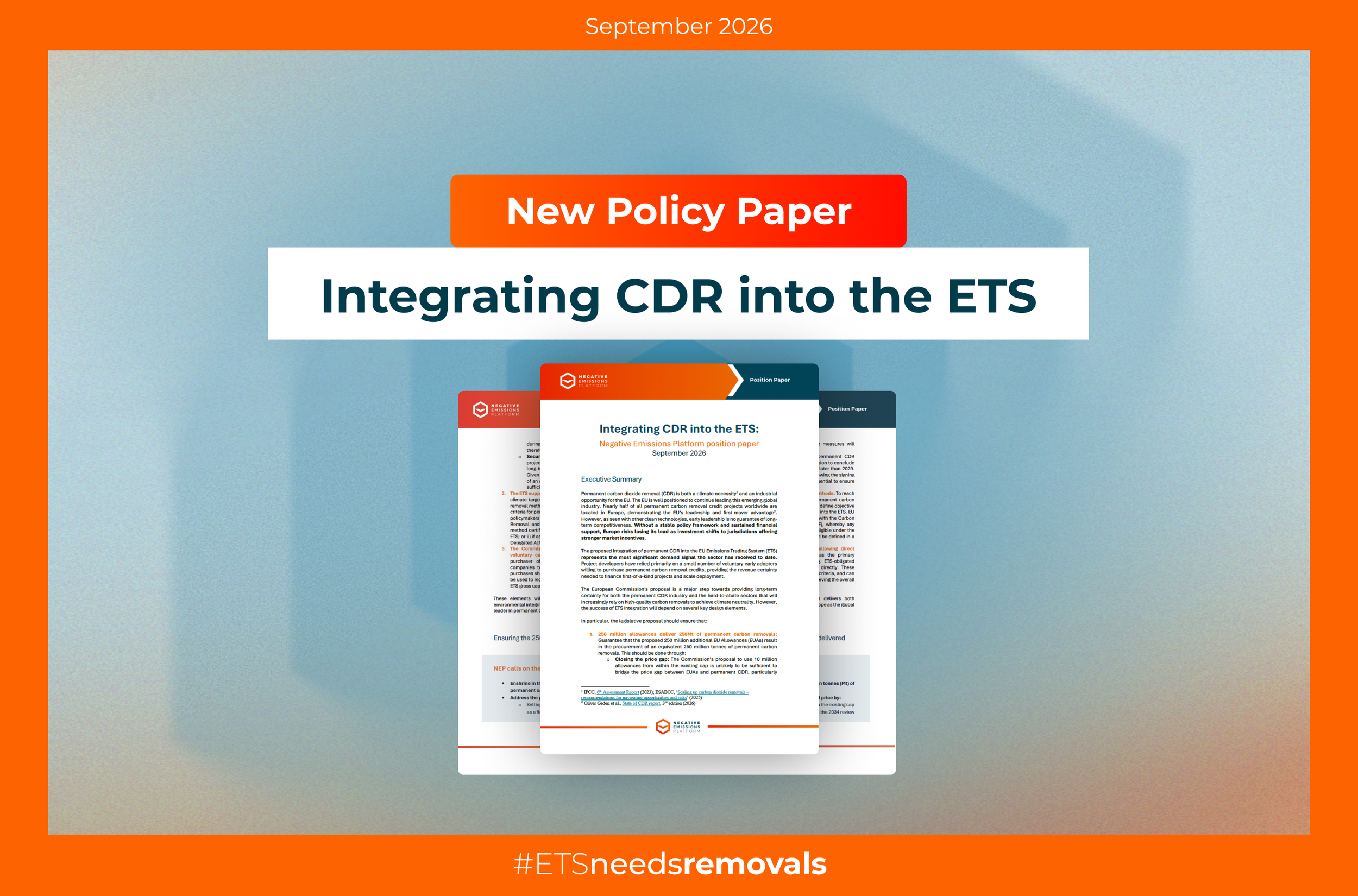
The Negative Emissions Platform has published a new position paper on integrating permanent carbon removals into the EU ETS
The EU ETS review is a major opportunity to give companies working to remove CO₂ from the atmosphere permanently the long-term demand and investment certainty they need to scale.NEP's position puts forward a few ways in which the ETS could improve the deliverability of carbon removals to prevent temperature overshoot
#ETSneedsremovals
Our Members are building an industry that Europe needs to reach climate neutrality. The proposed integration of permanent carbon removals into the EU ETS could provide an important long-term demand signal for the sector, but its success will depend on how the mechanism is designed and implemented.
To ensure the Commission’s proposal delivers for European industry and the climate, we have identified four key priorities.
Make 250 mean 250
The proposed 250 million additional allowances must deliver 250 million tonnes of permanent removals between 2031 and 2040.
For the mechanism to deliver on its climate objective, the additional allowances need to be matched by an equivalent volume of permanent carbon removals. Closing the price gap between EU allowances and the cost of permanent removals will be essential to making this possible and protecting the ETS’s climate integrity.
The Commission’s proposal already recognises the challenge by making additional allowances available to help address the price difference. However, further measures will be needed to ensure that the full volume of removals envisaged by the proposal can be delivered.
Contract early enough to deliver from 2031
Permanent carbon removal projects require significant investment and several years of development before they can begin delivering removals.
The Commission should therefore sign long-term offtake agreements as early as 2027 and no later than 2029, giving developers the revenue certainty needed to secure investment and bring projects forward in time to deliver from 2031.
Early commitments would provide developers with greater visibility over future demand and help create the conditions needed for new permanent removal capacity to come online when the ETS purchasing mechanism begins.
Give a broad portfolio of permanent removal methods a clear route into the ETS
The EU will need a broad portfolio of permanent carbon removal methods to reach its climate targets. The ETS should therefore provide a clear and predictable pathway for eligible permanent removal approaches to participate.
This should be supported by robust certification and objective eligibility criteria. A clear framework would give developers greater certainty about which methods can access the market, while ensuring that all removals included in the ETS meet the necessary standards for permanence and environmental integrity.
Permanent fossil emissions must be matched by permanent removals. Maintaining this like-for-like principle is essential to ensuring that the integration of carbon removals strengthens rather than weakens the environmental integrity of the ETS.
Allow industry to help build the market
The Commission should remain the primary purchaser initially, providing a central source of demand as the market develops.
At the same time, ETS operators should be enabled to directly purchase and use eligible permanent removals within the agreed allocation. This would provide an additional route for companies to contribute to the deployment of permanent carbon removals, while supporting the development of a broader market.
Allowing industry to participate alongside the Commission can help create additional demand for permanent removals while maintaining the overall boundaries of the proposed mechanism.
A long-term framework for permanent carbon removal
The integration of permanent carbon removals into the EU ETS represents an important opportunity to create a more predictable market for the sector.
Europe has the companies, expertise and industrial ambition to lead in permanent carbon removal. But maintaining that position will require a policy framework that gives developers and investors confidence that demand will be there as projects move from development to deployment.
The EU ETS review must provide that confidence while ensuring that every tonne of additional permanent removal contributes to the climate objective of the system.
Our position paper sets out concrete amendments to the Commission’s proposal to help achieve this.
