

Why a tightening cap needs removals, and why investment must start now
Paper · October 2026
By Felix Grey (Isometric), Molly Tinker (Climeworks) and Johan Börje (Stockholm Exergi)
Change brings opportunities. Climate change requires us to transition away from fossil fuels and find a balance in which residual greenhouse gas emissions are matched by carbon removals. This new balance is an opportunity for industrial leadership. It requires something the world has never seen before: an entirely new industry whose sole purpose is to counterbalance the residual climate impact of all other industries and economic activities.
This industry will be built in the context of a deep challenge facing the EU ETS: how to maintain a credible path to net zero, as the cap shrinks, allowances become scarcer and residual emissions remain. This paper makes a simple argument: to stay credible and affordable, the ETS needs allowances from permanent carbon removals, and because removals take decades to scale, the investment must begin now.
Under the Paris Agreement, the Parties committed to achieve a balance between anthropogenic emissions by sources and removals by sinks in the second half of this century, and the IPCC concludes that carbon dioxide removal to counterbalance hard-to-abate residual emissions is unavoidable if net zero emissions are to be achieved. The EU has translated this into law: the European Climate Law requires climate neutrality by 2050 and negative emissions thereafter. For the 90% net reduction 2040 target, the Commission has modelled the need for up to 75 Mt of industrial removals by 2040, reaching 114 Mt by 2050. Now, with the Commission’s proposal to revise the EU ETS in light of the 2040 target, the Union is poised to establish the pillar that has so far been missing from the implementation of the Climate Law: regulated demand for permanent removals.
The logic of removals is cost efficiency. Residual emissions lie at the steep end of the marginal abatement cost curve: eliminating the final tonnes of emissions from process industries, long-haul aviation as well as agriculture costs several times as much as removing an equivalent amount of CO₂. For hard-to-abate sectors, integrating removals in the ETS would make it possible to remain competitive as ETS emission allowances decline and other trading blocs develop their own approaches to residual emissions. The competitiveness case is further strengthened by the potential to share and amortise critical infrastructure across carbon removal projects and other capture and usage projects.
Building a domestic industry for permanent removals is fundamental both to the competitiveness of hard-to-abate sectors and the Union’s ability to reach its climate target in the most cost-efficient way with high integrity. The integration of permanent removals into the ETS also has the potential to drive innovation and growth, and to create new jobs in all Member States. The benefits are shared across the Union: Stockholm Exergi’s removal project, for example, relies on suppliers from at least 12 Member States (Stockholm Exergi, 2026). And the benefits could be large: in the Nordics alone, for example, the industry has the potential to support close to 150,000 high-quality jobs annually by 2050.
The ETS Needs Removals
The fundamental point is that the ETS needs allowances from removals if it is going to sustain net zero in an economically efficient way. By putting a price on emissions, the EU ETS has successfully driven significant emissions reductions over its first 21 years of existence. But the context is now evolving, as we move on to the decarbonisation of sectors and processes that are hard to abate, such as aviation, ammonia, steel or cement. To keep us on track for net zero in 2050, this requires continued steep reductions in the number of ETS allowances, over two distinct decades:
In the first decade, the 2030s, the cap on ETS allowances must shrink significantly, as the Commission has proposed. This is necessary for the climate, but will lead to increased carbon prices and potentially increased volatility, with potential competitiveness impacts on EU firms facing competition from non-EU trading partners with less stringent climate policies.
In the second decade, to 2050, the ETS must reach net zero emissions, and find a way to balance residual emissions with removals.
The policy challenge is to address both these issues, and this is why the ETS needs to integrate carbon removals.
Creating greater flexibility in the 2030s
In the 2030s, integrating removals achieves two key outcomes for the ETS: first, maintaining the net emissions trajectory necessary for Europe’s 2040 target while allowing greater flexibility for ETS industries; second, building and driving cost reductions in the removals industry that will be essential for the ETS in the 2040s.
On the first outcome, the ETS proposal increases the number of allowances by 250 million over the decade while the Commission will purchase 250 million tonnes of removals. The net impact of these changes on the atmosphere is zero. The immediate benefit to Europe is increased competitiveness of existing industry.
Scarcity of emissions allowances is set to significantly increase over the 2030s as the cap tightens, with just 200-300 million allowances set to be released in 2040, compared to approximately 1,200 million in 2026 as shown in Figure 1. This risks significant carbon price increases for EU industry. These sectors produce goods traded in international markets, with competitors not exposed to stringent carbon pricing. Significant carbon price increases risk relocating production to these jurisdictions, leading to carbon leakage. This would be bad for Europe’s economy and for the climate. There are powerful tools to mitigate carbon leakage in the form of CBAMs and free allocation, but these are complex and inevitably imperfect. The optimal policy mix is to combine them with the additional competitiveness mitigation that is carbon removal integration in the 2030s.
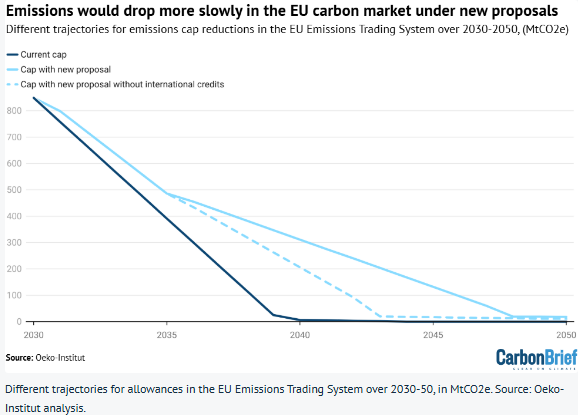
Figure 1: ETS allowance supply will fall dramatically over the 2030s. (Source: Carbon Brief reporting Oeko Institute Analysis.)
Best et al (2026) examine the impact of integrating CDR into the EU ETS under a scenario in which the deployment of other decarbonisation infrastructure is slower than expected, leaving industry with fewer abatement options. They find that even relatively small volumes of CDR introduced in the 2030s can have a substantial market impact. Allowing up to 40 MtCO₂/yr of removals, close to the European Commission's proposed 48 MtCO₂/yr for 2040, reduces carbon prices by 27%. The authors emphasise that CDR increases flexibility within the system by providing an additional compliance option. In their analysis, the greatest benefits accrue to the chemicals and "other industry" sectors, which would otherwise face higher costs if emissions reductions in harder-to-decarbonise industries, such as cement, do not materialise quickly enough.
An additional effect of removals integration which benefits European industry in the 2030s arises from the design mechanism of intertemporal banking. This refers to ETS participants purchasing and holding additional allowances in anticipation of a tighter emissions cap and higher carbon prices in future compliance periods. Without CDR integration, market participants would expect carbon prices in the 2040s to rise sharply as only the most hard-to-abate emissions remain. Anticipation that removals will help contain future prices reduces the incentive to bank allowances, contributing to more stable carbon prices already in the 2030s.
The second outcome removals integration will achieve in the 2030s is building the removals industry. This will be essential for the ETS in the 2040s, as set out in the next section. Building a removals industry at the necessary scale will take time. It has taken the modern renewable energy industry approximately 50 years to get to where it is now. We have only 24 years to 2050. Reaching 48 Mt of removals under the ETS by 2040 is an essential milestone on the trajectory to a net zero ETS in 2050. If we don’t reach it, there is no way we can suddenly turn on a removals industry in the 2040s.
In economic terms, removals integration in the 2030s is about dynamic efficiency. While removals are currently more expensive than emissions reductions in the ETS, and could stay that way well into the 2030s, there is a very strong policy case for investing now to drive learnings and standardisation to bring down costs so that removals can play a key role in the 2040s.
See Acemoglu et al (2012) for the classic study of the power of dynamic efficiency in climate policy. Supporting removals in the 2030s so they can reduce costs in the 2040s fits exactly into their paradigm.
Reaching an economically efficient net-zero
In the second period, the decade to 2050, the context is yet greater scarcity of allowances in the ETS and eventually the need to balance each continued emission with a removal, so that the overall system is net zero. The policy challenge is how to achieve this outcome in a sensible way. The answer from economics is clear: price emissions and removals so that each firm faces the right set of incentives. Firms should be incentivised to reduce their emissions wherever possible, while using permanent carbon removals to balance out emissions that remain. The ETS will deliver this outcome, so long as all new allowances come from removals. In economic terms, this creates a market where the marginal cost of emissions reductions equals the marginal cost of removals, for all firms. Standard economic theory tells us the result is a market that efficiently allocates emissions reductions and removals across the economy. In plainer English: the market guides everyone to get to net zero in as low-cost a way as possible. These lower costs keep firms competitive and are also passed on to households. Politically, policies that support the build-out of a domestic permanent removals industry to enable a cost-effective route to net zero with high environmental integrity are essential, as they maximise the chances of sustaining a coalition in favour of net zero over the decades.
The price impacts of permitting removals at this stage demonstrate how critical an ETS with removals fully integrated will be by the 2040s. Sultani et al (2026) model the impact of integrating CDR, and they conclude:
integrating permanent CDR into the EU ETS effectively moderates long-term carbon prices in the model. Compared with a counterfactual without CDR in the market, a direct BECCS and DACCS integration roughly halves EU ETS prices post-2050.
In their analysis, CDR effectively becomes the marginal price-setting compliance option. This reflects the intended role of removals within a net-zero framework: compensating for residual emissions that are prohibitively expensive or technically infeasible to abate. As a result, the carbon price is increasingly determined by the cost of delivering removals, rather than by the abatement costs of the most challenging industrial emissions sources.
It is fundamentally important to recognise that for substantial cost containment, early investment in CDR needs to occur. Whilst the impact of CDR on the ETS will be felt in the 2040s, those impacts can only emerge if investment begins today and costs come down allowing CDR to be a meaningful price stabiliser in the 2040s. Securing adequate funding for the first wave of removals is therefore critical, generating significant system-wide cost savings over time while enabling CDR to scale at the pace required.
What this means in practice
It is worth spelling out in real-world terms what these policy arguments mean. Suppose it's 2050 and there is a hard-to-abate plant, say a cement or ammonia plant, as typically found in any EU country. It produces goods the economy needs, and provides good jobs. If it goes out of business, people will still buy what it used to produce, but they will import those goods from abroad, where a plant would expand to meet the new demand.
In a world with removals integrated into the ETS, the plant can continue to operate, buying allowances from removals so that each tonne of its emissions is then removed from the atmosphere. Its operation therefore has a neutral impact on the atmosphere, i.e. it is operating at net zero. It continues to employ people and produce essential goods for the local economy, which do not need to be imported. The price of the allowances is higher than in the past, but not excessively high because a well-developed removal sector is providing liquidity to the market. The CBAM protects the plant against carbon leakage by maintaining its competitiveness. This is efficient climate policy.
In a world with no removals in the ETS, the picture is different. If the ETS stuck to net-zero consistent emissions trajectories with no removals, there would be very few if any allowances available by 2050, and the price would be very high. The plant would likely cease to be able to operate with costs so high. This trajectory, however, is not credible: there would inevitably be political intervention to weaken or abandon the ETS well before this outcome materialised. And the market knows this, so this trajectory will have been viewed as non-credible from the start. No significant investments will be made on the basis of a non-credible price projection, and the result will be uncertainty and stasis.
The contrast between the worlds with and without removals is ultimately about the credibility of climate policy. The world with removals offers a credible, efficient path for the ETS to bring our economies to net zero, in a way that cannot be achieved in the world without removals.
Concluding policy implications
The ETS Needs Removals. The question is no longer whether permanent carbon removals will be required to achieve climate neutrality, but how Europe can scale them at the pace and volume needed to support a cost-efficient net-zero economy. Integrating removals into the EU ETS is essential both to build the industry that Europe will need in the decades ahead and to ensure a credible and economically sustainable pathway to net zero. The challenge for the legislative process is therefore to ensure that the final ETS framework can deliver the 250Mt of permanent removals proposed by the Commission. The Negative Emissions Platform's ETS Policy Paper provides detailed recommendations on how the current proposal can be strengthened to achieve this goal.
Isometric is the agentic certification platform for the industrial economy. Its AI agents work alongside human verifiers, reviewing every data point so expert judgment is freed for the calls that matter.
Climeworks is a leading high-quality carbon removal provider, combining decades of expertise in Direct Air Capture (DAC) technology with holistic carbon removal solutions.
Stockholm Exergi is Stockholm’s energy provider. Using resource-efficient solutions, the company ensures that the growing Stockholm region has access to electricity, heating, cooling and waste services.